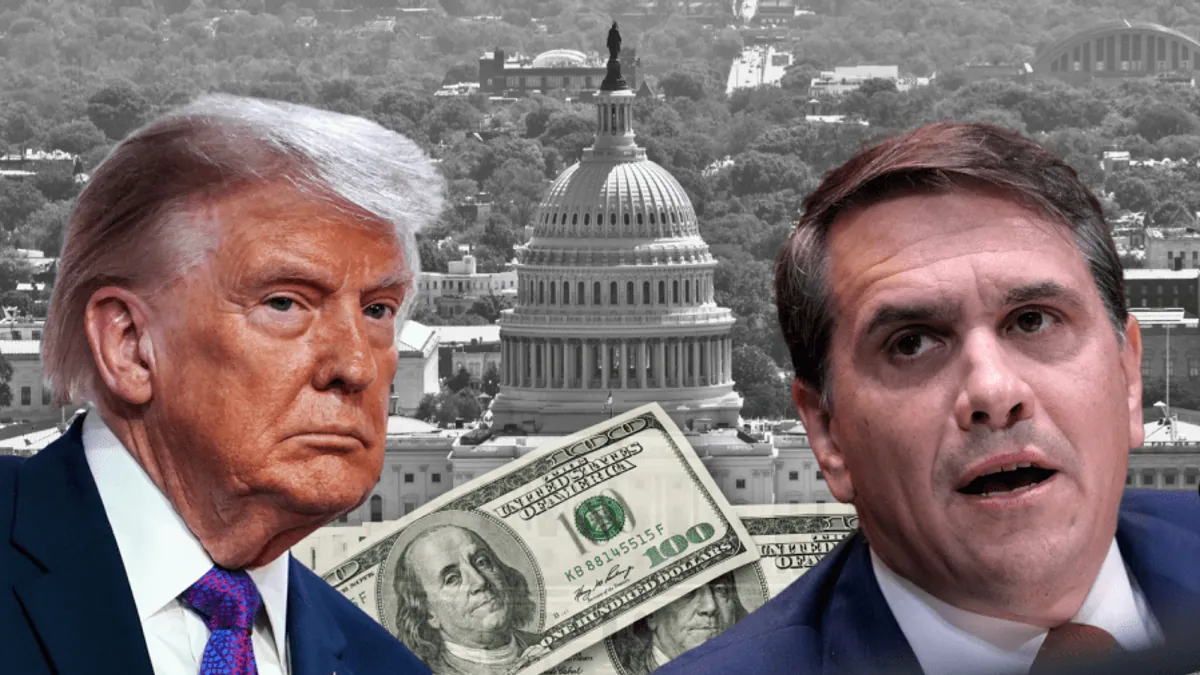
Last week, acting Attorney General Todd Blanche dropped two bombshells that sent the country reeling. The first was what the Justice Department deemed a “settlement agreement” between Donald Trump as plaintiff and Donald Trump as president. It basically takes $1.8 billion in taxpayer money and hands it to Trump to do as he pleases. The second is an addendum to the first document that claims as of May 19 to “release,” “waive,” “acquit” and “forever discharge” Trump, his sons, and the Trump Organization from any claims “whether presently known or unknown” not just by the IRS and the Treasury Department but also “other agencies or departments” of the U.S. government.
Critics are calling the settlement agreement a “slush fund” and the addendum “immunity from IRS audits.” But neither characterization meets the evident lawlessness. With such distorted and downplayed narratives, the public is missing three key points. First, the term “slush fund” elides the possibility that the fund is actually criminal. The term “slush fund” dates back to the mid-18th century, when old cooking grease — or “slush” — was collected and sold for the benefit of sailors when ships reached the shore after a long voyage.
In the 19th century, the term migrated beyond the shipping industry to mean all-purpose money (or “petty cash”) kept by a variety of businesses. In its most benign sense, “slush fund” still means “a pool of money that is reserved for unspecified or discretionary uses,” which is why it doesn’t quite capture what Trump and his Justice Department did last Monday. By the late 1800’s, “slush fund” came to mean a pot of money “associated with unethical practices such as bribery, payoffs, or personal expenditures without proper oversight,” a definition that inches closer to the $1.8 billion. Still, no court in our nation’s history has been asked to consider whether it is legal for a president to take money unilaterally from the capacious federal Judgment Fund with no judicial or congressional authorization, settlement agreement or live dispute with future claimants, and with no oversight or criteria for disbursement by hand-picked administrators.
Former federal prosecutor Glenn Kirshner has characterized it as another one of Trump’s “creative crimes.” But the fact that there is no precise law on the books specifically criminalizing this does not mean, as Kirschner described it, that the scheme was anything other than “overt, even gleeful corruption and theft of taxpayers’ dollars,” and “stealing our money from the U.S. Treasury to give it to bad guys.” Liz Oyer, former pardon attorney at the Justice Department, called it a criminal conspiracy. Former deputy U.S. solicitor general Philip Allen Lacovara wrote that it looks like “a classic example of a ‘collusive settlement,'” which is “a species of fraud” that “[m]ost typically … involve[s] self-interested deals in which a person with insurance agrees to settle a bogus claim or commits to an unreasonable payment in the home of foisting the costs on an insurance company.”
And as Anna Bower and Eric Columbus of Lawfare noted, if payouts are made to Trump-aligned individuals and companies, including people pardoned for crimes associated with the riot at the U.S. Capitol on Jan. 6, 2021, it could violate the Antideficiency Act, which makes “a federal crime to ‘knowingly and willfully‘ spend money not appropriated by Congress.” Second, although Trump is operating as if he is above the law, there is room for future courts to find liability for “creative crimes” he commits while in the White House. In giving Trump criminal immunity for official acts in July of 2024, the Supreme Court made clear that former presidents can still be prosecuted for crimes involving unofficial acts. This could theoretically cover even actions taken by Trump to minimize his personal tax liability. During Trump’s first term, even the friendly majority on the Supreme Court refused to protect his personal accounting firm from having to turn over his tax returns to a number of congressional committees.
In 2022, it refused to block a lower court ruling that Trump must disclose his tax returns and other financial records to the House Ways and Means Committee. Those decisions signal a potential willingness on the part of five justices to recognize a sliver of accountability for presidents even after their disastrous criminal immunity decision in Trump v. U.S. Third, Trump’s self-serving deal for IRS immunity might not hold up in the long run. The real question right now is not whether Trump has the constitutional authority to grant himself tax immunity and extend it to his sons and his business (he doesn’t), but whether voters will one day elect an administration willing to bring cases ostensibly covered by the addendum.
If that happens, Trump’s defense team would undoubtedly seek to have them thrown out under the terms of the addendum. In response, the government would argue that the addendum should be given no weight because Trump had no legal authority to grant himself such immunity in the first place. The whole thing is bogus, so any attempt to use it as a valid legal defense is bogus, too. Judges have a way of sniffing out these sorts of shenanigans.
In Trump’s $10 billion lawsuit giving rise to these “agreements,” the statute of limitations had run and the judge already signaled that there was no live controversy because Trump was suing himself as president. His lawyers withdrew the case before she could rule. That should give rule-of-law Americans comfort that the courts are still functioning in the U.S. The trick right now is to elect politicians who will function as protectors of the Constitution, too. That requires calling out what’s happening for what it really is.
Kimberly Wehle is a professor at the University of Baltimore School of Law and author of “How to Read the Constitution — and Why,” as well as “What You Need to Know About Voting — and Why” and “How to Think Like a Lawyer — and Why.“