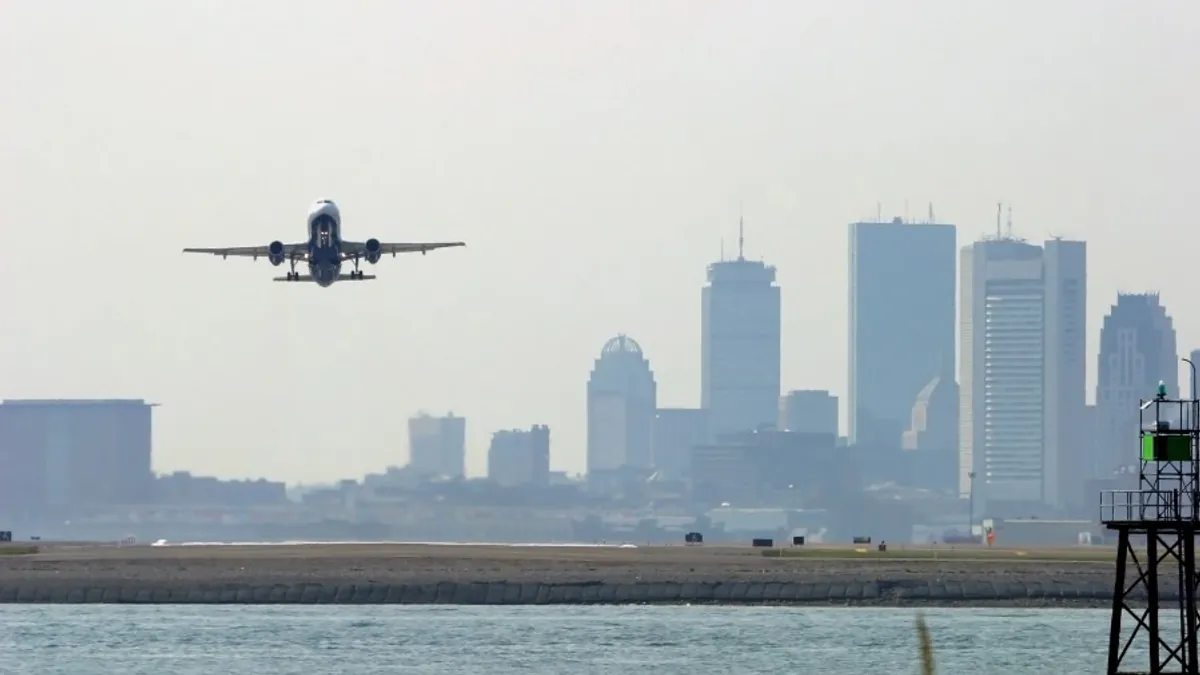
The Massachusetts Port Authority is participating in a new pilot program, in conjunction with the Transportation Security Administration, in an effort to improve efficiency in airport screening procedures. Starting June 1, people flying out of Boston Logan on either Delta or JetBlue (their two largest carriers) can be screened in Framingham, hop on a bus, and get dropped off on the sterile side of the airport without passing through additional screening — all for the price of $9, not including the $7 per day parking. For those living in the western suburbs of Boston who do not want to make the 25-mile trip to Logan on their own and deal with on-site airport parking, or traverse the route via public transportation, this looks like a winning option. It may also provide an airport security screening model for other large airports in congested urban areas, such as New York-LaGuardia, Atlanta Hartsfield or Los Angeles International.
Creating a remote airport security screening facility is no different from setting up an airport security screening terminal, except that the departing transportation is by bus rather than by plane. This makes the Framingham terminal much like a regional airport, with screening checkpoints subject to the same TSA-mandated technologies, procedures and requirements. Yet with a much smaller operation, any equipment breakdowns or TSA officer no-shows could shut the remote terminal down temporarily, forcing the passengers to ride the bus to Logan but pass through screening there. Once people are screened at the remote terminal, they are part of the sterile side of the air system, even if they are not physically at Logan.
This effectively makes the bus an aviation security cocoon that must remain sealed until the travelers disembark into the airport. The bigger issue is the trip between Framingham and Logan. Interstate 90 into Boston can get backed up, particularly during morning rush hour. Disruptions, including accidents and breakdowns, can wreak havoc on schedules.
If buses in this program break down or are involved in accidents themselves, the people on the bus will need to be rescreened at Logan once they get off, likely dealing with a missed flight. There is also the issue of securing the buses themselves, particularly if they are not dedicated to airport transportation. The people involved in servicing and maintaining these buses must be subjected to the same security vetting as the airline workers servicing and maintaining airplanes at airports. The bus service area must also be secured like the areas at airports where airplanes are serviced.
If this is not possible, an unforeseen risk is added. In the worst case, items banned by the TSA could be hidden on these buses, then be accessed by a person who is screened at the Framingham terminal. Boston Logan had more than 21 million departing passengers in 2025, with around 90 percent originating at the airport. This means that Logan’s airport security checkpoints screen over 50,000 people on average every day.
Based on the proposed schedule, the Framingham terminal may process as many as 1 percent of these passengers, with minimal effect on the airport security checkpoint passenger flow and waiting times. What this pilot program is designed to do is determine whether remote airport security screening terminals are feasible. Yet before resolving this issue, the bigger question is whether the same standard of security can be maintained using a remote screening terminal. Under ideal conditions, the answer appears to be yes.
Yet ideal conditions are rarely present all the time (otherwise they would not be labeled ideal). Weather conditions and traffic delays will create uncertainty. Access to the buses used for the trip to Boston Logan cannot be secured as well as airplanes at an airport. A better pilot program for a remote terminal would be limiting passengers to those who are TSA PreCheck vetted.
The TSA officer staffing levels and technologies deployed would be more manageable for a remote terminal. This would have been the ideal environment to test the concept while mitigating some of the potential risks before a full-scale remote security checkpoint terminal is launched. The size of remote terminals also makes them easy for transition to privatization through the TSA Screening Partnership Program. The recently announced TSA Gold-plus program is a step in this direction, pushing more airport security operations and technology procurement to private contractors and the airports while letting TSA continue overseeing aviation security policies and procedures.
The Boston remote security checkpoint is a novel idea, well worth exploring. The biggest concern is how well buses can be secured. Limiting travelers on these buses to PreCheck passengers would be one way to mitigate some of this risk while assessing the feasibility of the model. Looking ahead to using such a model at other airports requires careful vetting during the pilot program to ensure that additional risks are not inadvertently introduced.
Sometimes moving full speed ahead may end up slowing progress, not speeding it up. Sheldon H. Jacobson, Ph.D., is a professor of computer science in the Grainger College of Engineering at the University of Illinois Urbana-Champaign. He has researched risk-based aviation security for over 25 years, which provided the technical justification for TSA PreCheck.