
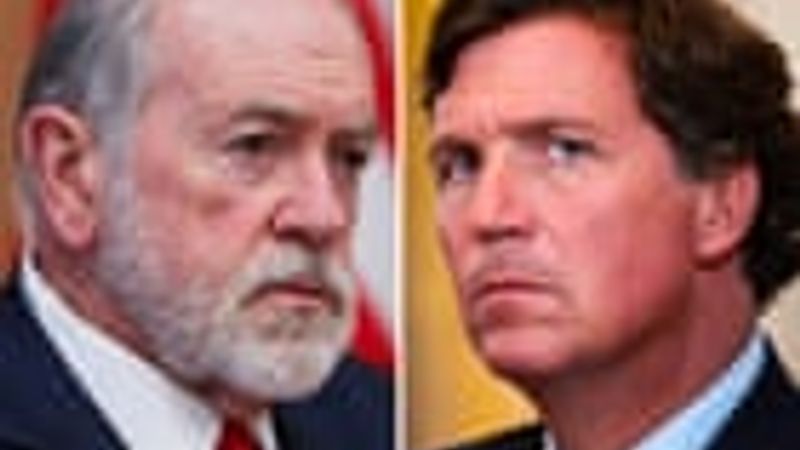
The interview, staged with the sterile backdrop of an international airport, was anything but sterile. It was a proxy battle fought on Israeli soil over the future of American power and identity. On one side stands Carlson, channeling the new MAGA isolationism: a transactional, 'America First' nationalism that views blank-check support for any foreign nation—even Israel—as a betrayal of the homeland.
Opposite him is Mike Huckabee, the former governor and avatar of an older, deeply embedded Christian Zionism. For this camp, support for Israel is not a matter of geopolitics but of biblical prophecy. It’s a non-negotiable article of faith, rendering debates over national interest or financial cost as blasphemy. Huckabee, speaking for a generation of evangelicals, sees Israel’s claim to the Middle East as divinely ordained, a position immune to public opinion or political calculus.
This ideological collision was inevitable. For decades, the Republican party maintained a fragile but effective coalition between its nationalist, evangelical, and foreign policy hawk factions. Christian Zionism acted as the theological glue for an interventionist foreign policy. But the 'America First' doctrine, once a convenient slogan, is now a purity test being applied to every sacred cow of the old GOP establishment—and the US-Israel alliance was always the most sacred.
What Carlson’s confrontational style exposed is that for a growing segment of the MAGA base, the 'why' behind supporting Israel no longer resonates. They are animated by a suspicion of foreign entanglements and a belief that American resources should be spent at home. They hear Huckabee’s talk of divine right not as a statement of faith, but as the justification for another endless foreign commitment that benefits a globalist elite at the expense of the American heartland.
The implications are profound. This isn’t a fringe debate; it’s a fundamental challenge to a cornerstone of U.S. foreign policy that has enjoyed bipartisan consensus for half a century. The clash at Ben Gurion signals that the fusion of interests that defined the conservative movement is cracking. The battle is now between a transactional, nationalist 'America First' and a theological, covenantal 'Israel First.' The victor will define American conservatism's relationship with the world for the next generation.